Laos Travel Guide
BRIEF INTRODUCTION
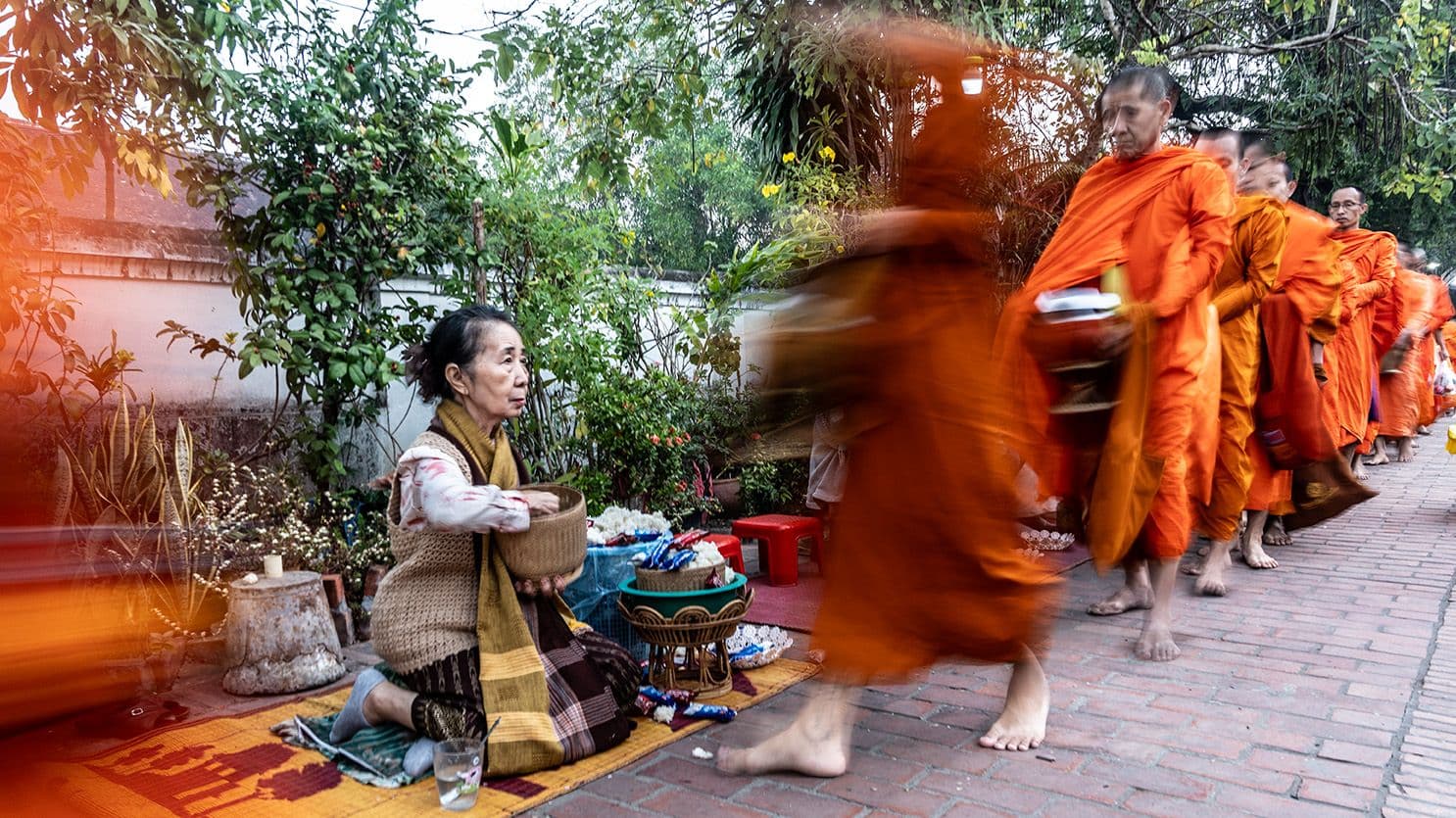
Tucked between better-known neighbors, Laos reveals itself slowly, but richly, to those who venture in. With its tranquil pace, saffron-robed monks, mist-shrouded mountains, and timeless Mekong River vistas, this is a country where ancient tradition and gentle hospitality still shape daily life.
Whether you're wandering through the golden temples of Luang Prabang, drifting past limestone karsts in a riverboat, or savoring spicy larb in a quiet village, Laos invites you to breathe deeply, unplug, and immerse in an Asia that feels beautifully unhurried and deeply authentic.
TOURISM INSIGHT
Tourism in Laos began to gradually open in the early 1990s after decades of political isolation, and the tourism sector has since grown steadily. In recent years, the country has welcomed over 4 million international tourists annually, drawn by its authenticity, tranquility, and natural beauty. Post-COVID recovery has been slower than in neighboring nations, but it is showing strong upward trends.
Tourism remains less developed than in neighboring countries, appealing to discerning travelers who value authenticity, tranquility, and cultural depth. It is a destination for reflective exploration rather than rapid sightseeing.
Key destinations include:
- Luang Prabang: A UNESCO World Heritage city famed for its golden-roofed temples, French colonial villas, and serene atmosphere. Ideal for soft cultural immersion and wellness travel.
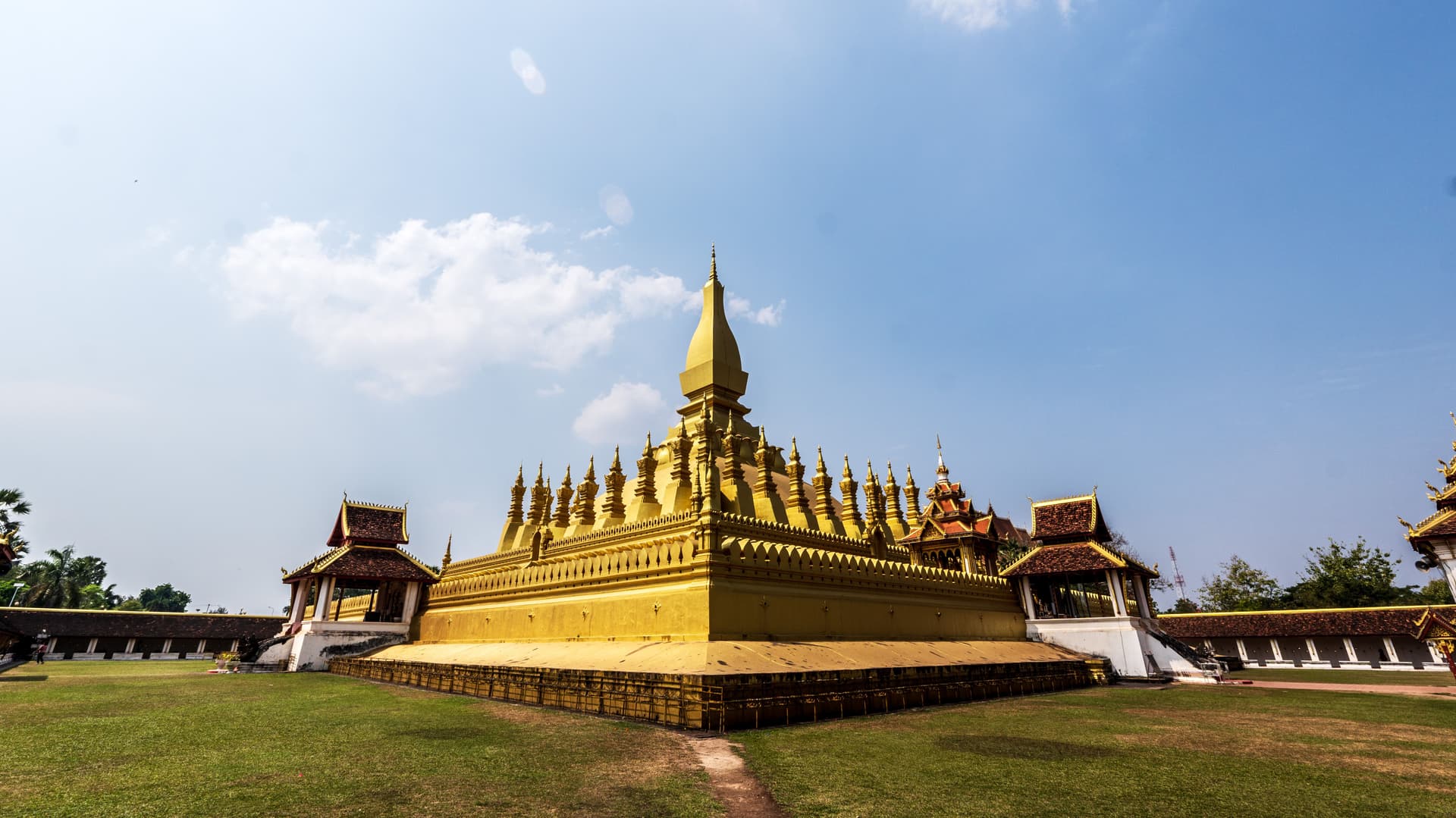
- Vientiane: The capital city retains a small-town feel, with significant Buddhist monuments such as That Luang Stupa and a growing dining scene.
- Xieng Khouang / Plain of Jars: Home to mysterious megalithic stone jars scattered across vast plains, bearing witness to ancient civilizations.
- Si Phan Don (4,000 Islands): A tranquil riverine area on the Mekong, popular for relaxation, waterfalls, and glimpses of rare Irrawaddy dolphins.
- Pakse & Champasak: In southern Laos, these towns offer access to the pre-Angkorian temple complex of Wat Phou and the Bolaven Plateau’s coffee plantations and waterfalls.
- Oudomxai: A key hub in northern Laos for accessing minority and hill-tribe cultures, remote villages, and mountainous landscapes.
PRACTICAL INFORMATION
Visa & Entry Requirements
This information is accurate as of June 2025. For the most current and reliable updates, please refer to the official website and confirm details before your departure.
IMPORTANT
If your flight to Laos transits through Thailand, you must complete the Thailand Digital Arrival Card before travel. Foreigners are required to submit their arrival card information at least 3 days before their arrival date in Thailand. Submit the form online at https://tdac.immigration.go.th/arrival-card/#/home
Visa on Arrival (VOA):
- Availability: Offered at Vientiane, Luang Prabang, and Pakse international airports, plus major land entry points such as Laos–Thailand Friendship Bridges I–IV, Boten (China), Mohan–Boten border, and certain Cambodia and Vietnam crossings.
- Fees: The Standard fee is USD 40 for most nationalities, with lower rates (USD 20) for Chinese and Vietnamese citizens.
- Requirements: Present a passport valid for at least 6 months with a blank page, 2 4 x 6 cm photos, and the visa fee in crisp USD.
- Surcharges: Expect a USD 1 fee for early/late arrivals, weekend arrivals, or arrivals on public holidays, which is commonly applied even during regular hours at land borders.
E‑Visa:
- Application: Available via the official portal laoevisa.gov.la, e-Visas grant a 30-day single-entry stay and are accepted at three international airports and key border posts.
- Processing: Takes 3–5 business days.
- Cost: Approximately USD 50, with small additional service fees.
- Advantage: Streamlined border entry, bypassing VOA queues, ideal during peak seasons.
Important Insights from Travelers:
- Border crossings can be unpredictable; have exact USD ready and be prepared for possible additional "processing" fees or informal charges.
- Some land border crossings (e.g., Namsoi-Vietnam) don’t accept VOA or e‑Visas, requiring nationals of those countries to arrange visas in advance.
ELECTRICITY
It’s generally available nationwide, though reliability varies between urban and rural areas. Major cities such as Vientiane and Luang Prabang enjoy stable power, while more remote villages may experience occasional outages or voltage fluctuations.
The national grid operates at 230 V/50 Hz, with European-style two-pin round sockets standard. Travelers from North America or from countries that use 110 V will need voltage converters and plug adapters. Seasonal changes, particularly during the dry season, can affect hydropower output, leading to variability in service.
Infrastructure improvements are ongoing, including upgrades to transmission lines and transformers, aiming to enhance reliability. Travelers planning to visit rural or remote areas should be prepared for occasional interruptions or voltage drops.
For convenience, hotels, guesthouses, and lodges in tourist areas typically provide standard outlets compatible with international devices. Power banks or small travel converters are recommended for extended stays outside urban centers.

INTERNET & SIM CARDS
There is reliable 4G in major towns and tourist areas. Limited 5G is available in parts of Vientiane and a few urban centers, but coverage remains patchy. SIM cards are easy to purchase on arrival from Unitel, Lao Telecom, or ETL. Typical tourist data plans cost around USD 5–10.
Another increasingly popular option is the E-Sim (Electronic Sim). If your phone supports it (most modern smartphones do), you can purchase and install the virtual Sim before departure, so your phone connects automatically upon landing.
Note: If using a local SIM or E-Sim, your home-country number will be inactive, but WhatsApp and similar apps remain functional as long as account settings aren’t changed.
Travelers can purchase prepaid SIM cards upon arrival at airports, mobile shops, or convenience stores. Leading providers include Unitel, Lao Telecom, and ETL, offering competitive data plans and flexible top-up options. A passport is required for registration. Data coverage is sufficient for email, navigation, and light media use in most towns, though speeds can slow in mountainous or remote regions. E-Sims are also available for compatible devices, providing a convenient alternative to a physical SIM card.
Hotels, cafés, and restaurants in major tourist hubs generally provide Wi-Fi, but the connection may be slower or less reliable outside these areas. Travelers venturing into rural or off-the-beaten-path destinations are advised to carry a local SIM, eSIM, or portable hotspot device to ensure consistent access.
CURRENCY AND MONEY
The local currency is the Lao Kip (LAK). Please check the USD=LAK rate here.
As of June 2025:
- 1 USD ≈ 21,594.5 LAK
- 1 EUR ≈ 24,875 LAK
Credit cards are accepted at mid- to high-end establishments, but cash is essential in rural areas. ATMs are available in cities, but most ATMs impose a withdrawal limit of 1–2 million Kip (approx. USD 50–100) per transaction. Foreign card fees (around 20,000-30,000 LAK per transaction) and your home bank’s charges may apply.
IMPORTANT
If you bring foreign currency notes (USD or EUR), ensure the bills are new, clean, and free from marks or tears. For US dollars, bills issued before 2006 are often not accepted due to counterfeiting concerns. Larger denominations, such as USD 100 or EUR 100, are generally easier to exchange and offer better rates.
TIPS (GRATUITIES)
Providing a tip is not obligatory, but it is customary to show appreciation for the exceptional service rendered by professionals who support your journey in the tourism sector.
Here are our recommendations for tipping:
- Guides: USD 8–12 per guest per day
- Drivers: USD 4–6 per guest per day
- Porters and hotel staff: USD 1–2 per service.
PERSONAL EXPENSES
Before your trip, please review your proposal carefully to understand what is included in your package and what is not. If not sure, contact us.
Travelers should budget for lunches and dinners not included in the itinerary, as well as souvenirs, extra food and drinks, communication, laundry, and other personal expenses. We recommend budgeting around USD 50 per person per day, adjusting based on dining choices, shopping habits, and drink preferences.
Laos is also known for its exceptional crafts: locally woven textiles in rich natural dyes, intricate silver jewelry, and hand-carved wooden items are widely available. In Luang Prabang, the night market is especially brimming with high-quality artisan goods that make for meaningful souvenirs or gifts. Spa treatments, cultural performances, and donations at temples may also arise as thoughtful gestures or spontaneous choices during your journey. Expect moderate daily expenses for:
- Additional meals, drinks, and snacks
- Laundry services
- Souvenirs and textiles, if interested
- Optional spa treatments or performances
International grocery store chains in Laos are limited and primarily concentrated in Vientiane and Luang Prabang. Supermarkets such as Big C and City Market offer a selection of imported food and beverage products catering mainly to expatriates and affluent locals. Convenience stores with international brands are scarce, and outside these urban centers, the availability of imported groceries is minimal. Hotels and resorts in tourist areas may stock a modest range of international products for visitor convenience.
HEALTH
We are not authorized to provide medical advice. Please consult your doctor before your trip about vaccinations or precautions. If you take regular medication, bring enough for the entire trip, as some medicines are hard to find outside of your country. Always carry medications in your hand luggage, not checked baggage.
Medical record and liability release: All travelers must complete and sign a trip application form, which includes these documents.
In Vientiane, Luang Prabang, and Savannakhet, travelers can find private hospitals and clinics with reasonably modern equipment and some English-speaking staff. Healthcare is basic, and serious medical cases often require evacuation to Thailand, Vietnam, or other nearby countries.
Mosquito-borne illnesses, including dengue fever, malaria, and Japanese encephalitis, are present, particularly during the rainy season (May–October) and in southern lowland areas. Water- and food-related illnesses, such as travelers’ diarrhea and hepatitis A, are common; drinking bottled or purified water and eating well-cooked food are strongly recommended. Heat exhaustion and dehydration can occur in hot months, and rabies is present among stray animals, so prompt attention is required if bitten or scratched.
Ensure routine immunizations are up-to-date. Recommended vaccines include Hepatitis A and B, Typhoid, Japanese Encephalitis, and Rabies for those visiting rural or jungle regions. Malaria prophylaxis may be advised for travelers venturing into the southern lowlands or forested areas. Drink only bottled or purified water. Eat thoroughly cooked food and exercise caution with raw vegetables or unpeeled fruits.
TRAVEL HEALTH INSURANCE
Valid travel insurance is mandatory for all travelers. Your policy must cover medical evacuation, including emergency air transport back to your home country.
Carry both printed and digital copies of your insurance certificate, along with your policy number and your insurer’s 24/7 emergency contact details. If anything unexpected happens during your trip, our team and local partners will assist where possible, including helping you communicate with medical staff and your insurance company.
A suitable travel insurance policy should cover the following:
- Emergency medical treatment (including hospital care and prescription medication)
- Medical evacuation to another country if necessary
- Repatriation to your home country in case of serious illness or accident
ACCOMMODATIONS
Laos offers a wide range of accommodations, from simple village homestays where you sleep on thin mattresses in shared family spaces, to luxurious resorts. In major cities and near key tourist sites, options range from guesthouses to high-end hotels. Unless otherwise requested, we typically reserve four-star hotels. When a four-star option is unavailable, we select the next-best option, often a three-star property or, occasionally, a well-kept guesthouse or homestay.
Standard hotel check-in is at 2 PM, and check-out is at 12 PM. Many hotels allow early check-in if rooms are available, but to guarantee this, we recommend arranging it in advance; supplements may apply. For late check-outs, it's best to inquire with the hotel reception the night before departure, though many properties offer a 2–4-hour grace period. If you're considering a triple room, be aware that few hotels in Laos offer proper triple rooms. Most offer a double bed with a rollaway or a twin room with a fold-out bed. These setups may feel cramped, and the extra bed can be uncomfortable. We can book a triple room if required, but we recommend considering these limitations.
When selecting accommodations, we consider location, service standards, renovation history, booking flexibility, and value. We also prioritize practical details such as breakfast quality, room cleanliness, and responsiveness of service. Hotel standards can shift over time, so we greatly value your feedback to help keep our recommendations accurate and up to date.
TRANSPORTATION AND TRAVEL
Overland travel remains the backbone of exploring Laos, offering a window into its serene landscapes and village life. While road infrastructure is gradually improving, routes can still be rugged, especially in mountainous or rural regions. We arrange comfortable, well-maintained vehicles operated by professional, local drivers, ensuring safety and ease on long drives.
For those seeking to cover greater distances efficiently, domestic flights between Luang Prabang, Vientiane, and Pakse offer a convenient alternative, significantly reducing travel time. Laos is also home to the newly opened high-speed railway, built by China as part of the Belt and Road Initiative. This modern rail line has transformed travel across northern Laos, providing a fast, clean, and reliable way to connect major towns, with onward connections to China in the north and Thailand in the south. In addition, river travel remains an important part of the Lao experience. From private longtail boats to multi-day river cruises, waterborne journeys connect scenic towns and remote areas while offering a close look at daily life along the Mekong and its tributaries
IMPORTANT
If your itinerary includes travel on the Laos–China Railway, please note that security procedures are strict and similar to those at the airport. All luggage is scanned, and prohibited items are confiscated without exception.
The railway prohibits:
• Sharp objects (knives, scissors, multi-tools, nail clippers)
• Flammable or explosive items (lighter fluid, fuel canisters)
• Aerosols and pressurized sprays (deodorant, hairspray, spray sunscreen)
• E-cigarettes and vaping devices (illegal in Laos)
• Hazardous materials, controlled substances, and live animals
Carry-on baggage is officially limited to 20 kg per person. Borderline items such as aerosols, tools, or certain medications may be confiscated at the discretion of station security. Personal medications are generally permitted if kept in original packaging and supported by a prescription when required.
To avoid delays or loss of belongings, pack conservatively and avoid carrying restricted items when traveling by train.
NOTE: If you are traveling with heavy or multiple pieces of luggage and your itinerary includes train travel, we recommend arranging luggage transfer in advance. Luggage space on trains is limited, and handling large bags can be inconvenient. Please refer to your trip proposal, and contact us if you would like us to arrange separate luggage delivery for an additional fee, so you can travel comfortably and hands-free.
FLIGHTS AND BAGGAGE
Laos is accessible via three main international airports: Wattay International Airport (Vientiane), Luang Prabang International Airport, and Pakse International Airport. Most inbound flights connect through major regional hubs such as Bangkok, Hanoi, Kuala Lumpur, and Singapore. Flight durations to Laos are generally short from neighboring countries, making regional extensions or multi-country itineraries seamless.
Luggage Allowances: For international flights, standard economy class allows 20-23 kg (44–51 lbs) of checked baggage and 7-8 kg (15–18 lbs) for carry-on luggage, depending on the airline. Business class typically offers 30-40 kg (66–88 lbs) of checked baggage plus hand luggage. Baggage limits vary by airline and ticket type, so please check their exact allowance directly with the airline before departure.
Domestic flights in Laos, however, are more restrictive:
- Checked baggage: Usually 20 kg (44 lbs)
- Carry-on: Limited to 5–7 kg (11–15 lbs)
FOOD
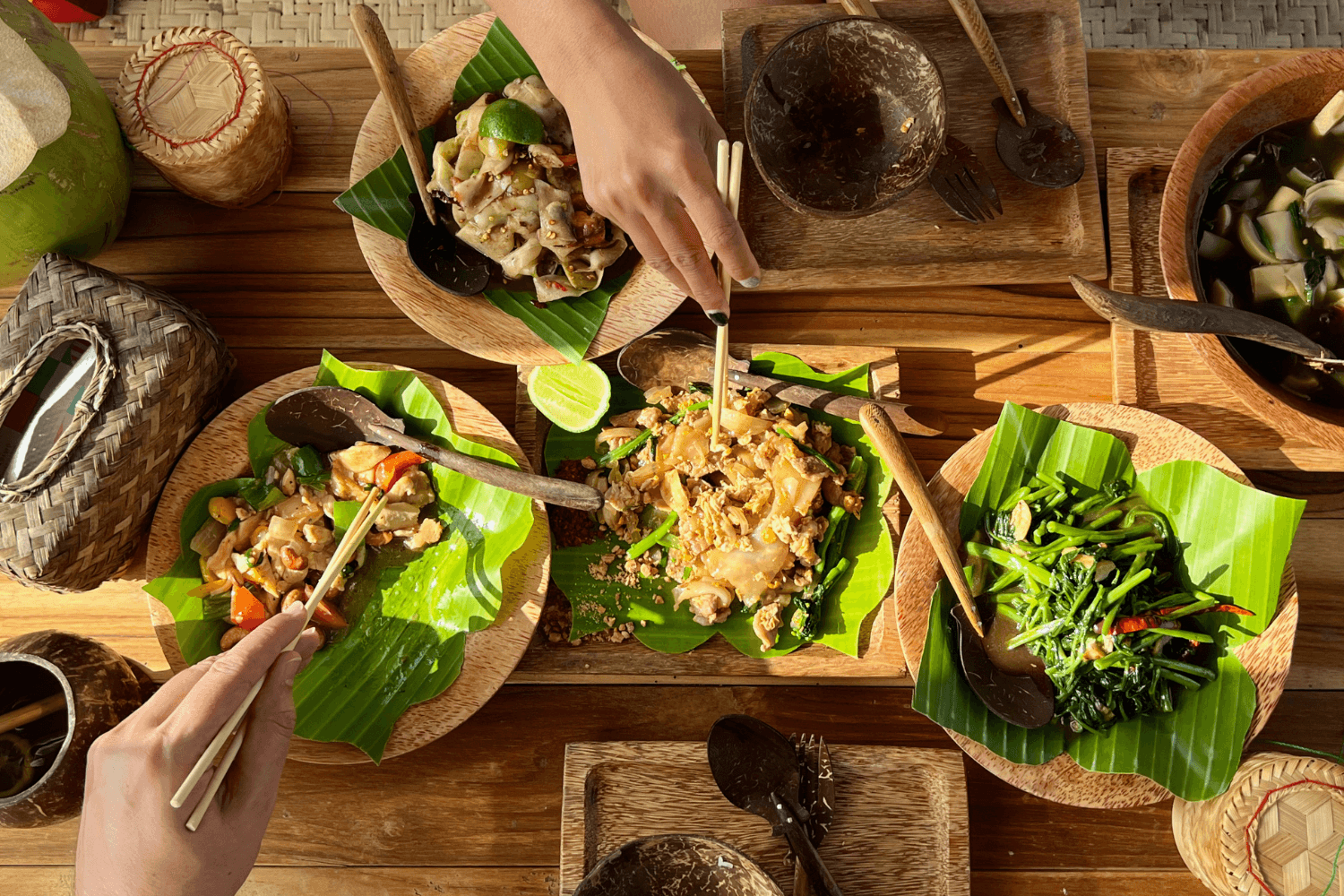
Laotian cuisine is one of Southeast Asia’s best-kept culinary secrets, vibrant, herb-forward, and grounded in freshness. Sticky rice (khao niew) is the national staple, eaten with the hands and served alongside an array of dishes.
The French colonial legacy lives on in Laos’ baguettes, croissants, and strong drip coffee served with sweet condensed milk. Street food is often simple but flavorful; grilled meats, noodles, and fresh tropical fruits dominate morning markets. In more refined restaurants, visitors can expect tasting menus that reinterpret traditional dishes with elegance. Vegetarians will find ample options due to the heavy use of herbs, vegetables, and rice-based staples. However, advance notice of dietary needs ensures better preparation, particularly in remote areas.
Dining in Laos is a cultural affair; meals are typically shared family-style, and the pace is slow, echoing the unhurried rhythm of life. Whether enjoying riverside dining in Luang Prabang or a humble village meal in the highlands.
Staple dishes include:
- Laap (Larb): Considered the national dish of Laos, this minced meat salad is flavored with lime, fish sauce, herbs, and toasted rice powder. Often eaten during celebrations and shared communally.
- Khao Niew (Sticky Rice): A daily staple rather than a side dish. Sticky rice is eaten with the hands and accompanies almost every Lao meal.
- Tam Mak Hoong: Lao green papaya salad, bolder and more pungent than its Thai counterpart, typically seasoned with fermented fish sauce and chilies.
- Or Lam: A hearty northern Lao stew from Luang Prabang made with meat, herbs, vegetables, and the distinctive woody pepper vine that creates a numbing sensation.
- Khao Piak Sen: Comforting Lao rice noodle soup, thicker and chewier than Vietnamese phở, often served with chicken or pork and fresh herbs.
CULTURAL ETIQUETTE & MODESTY NORMS
In Laos, respect is expressed quietly but deeply, and visitors who show humility and cultural awareness will be warmly welcomed. Buddhism shapes the rhythm of daily life, and with it, a strong emphasis on politeness, calm demeanor, and modest behavior.
- Dress modestly, especially when visiting temples: shoulders and knees should be covered, and shoes removed before entering sacred spaces. Lightweight, breathable clothing that meets these expectations is recommended for the tropical climate. Avoid revealing attire, even in casual settings.
- Physical gestures matter. The Lao greeting, the nop, involves pressing your palms together at chest level and offering a gentle nod. It’s a sign of respect, especially when addressing elders or monks. Do not touch anyone’s head (considered the highest and most sacred part of the body), and avoid pointing with your feet or sitting with the soles facing others or sacred objects.
- Public displays of affection are considered inappropriate. A modest, composed demeanor, especially in rural areas, is deeply appreciated.
- When interacting with monks, women should not touch them or hand anything directly. If you wish to make an offering, place it on a cloth or have a male intermediary place it.
Politeness, a gentle tone, and a genuine interest in local ways will open doors. In Laos, grace and modesty are not just cultural expectations; they’re a way of life.
WEATHER AND RECOMMENDED SEASONS
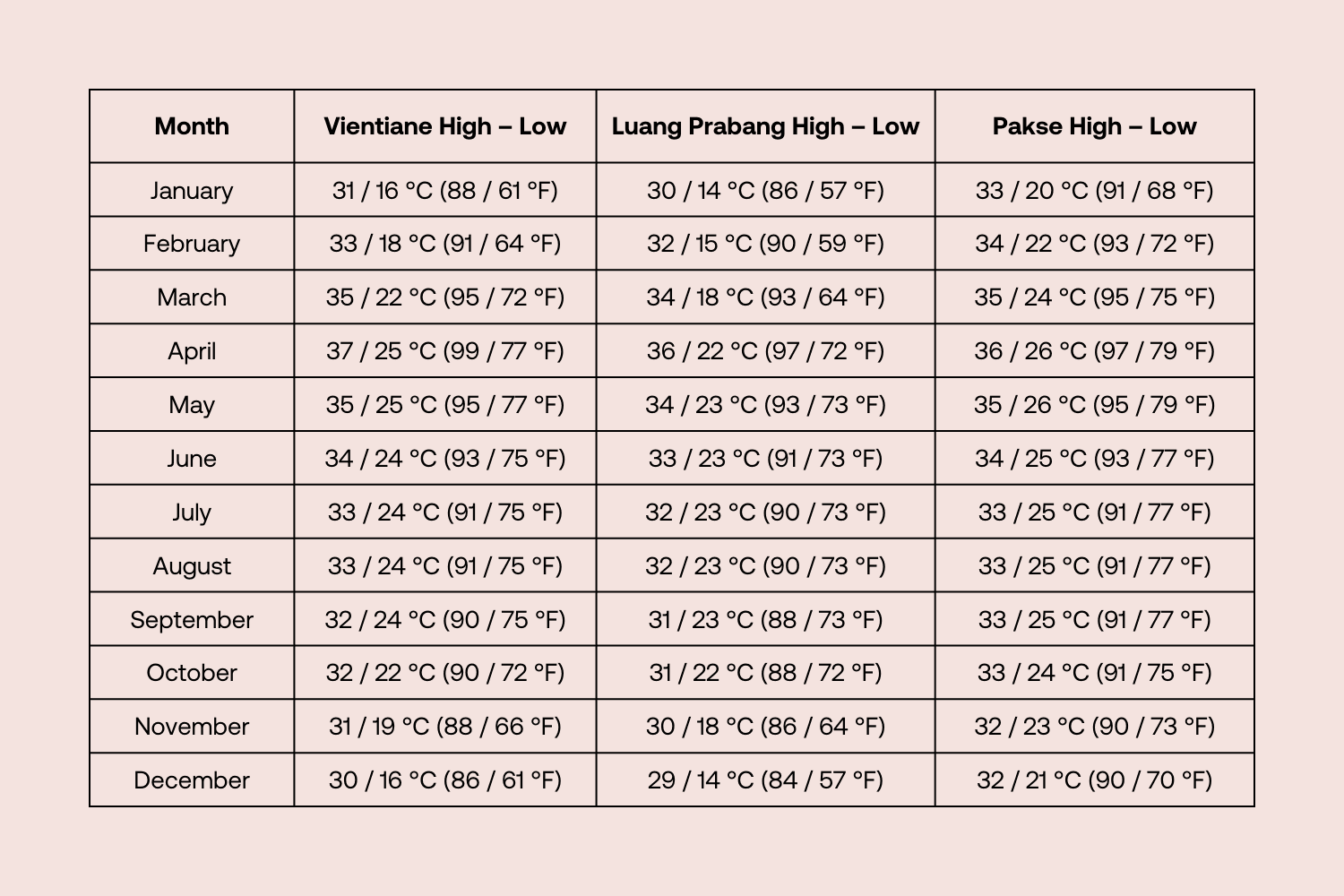
Luang Prabang: Northern climate with mild dry-season nights and hot pre-monsoon days (peak ~35 °C).
Vientiane: Central plains with warm winters, very hot pre-monsoon months (April ~35 °C); occasional record highs up to 42 °C
Phonsavan: Higher elevation yields cooler winters (lows around 7–11 °C), and milder summers (highs around 27–29 °C)
- Cool & Dry Season (Nov–Feb): Ideal travel period. Pleasant temperatures and minimal rain.
- Hot Season (Mar–May): Higher temperatures, particularly in the lowlands.
- Wet Season (Jun–Oct): Lush landscapes but occasional travel disruptions due to heavy rainfall.
RECOMMENDED PACKING LIST
Our suggested packing list is not meant to be exhaustive; every traveler has different needs. If you feel there is something else you should bring, please do so. When in doubt, contact us for advice. The following general packing list recommends the equipment or clothing we have found most practical in Laos, based on our experience.
Essentials
- Travel insurance policy details (printed and digital)
- Local currency and backup credit/debit card
- International travel adapter to charge your devices
- Unlocked smartphone + local SIM card/ E-Sim installed/ or roaming enabled
Clothing
- Lightweight tops (cotton, linen, moisture-wicking)
- Long-sleeve shirts for sun and cultural sensitivity
- Waterproof jacket
- Comfortable walking shoes
- Sandals or slip-ons (for hotel or light walking)
- Modest attire for temples or rural visits (cover shoulders and knees)
- Smart-casual outfit for fine dining or cultural events
- Undergarments & sleepwear
- Sunhat or cap
- UV-protective sunglasses
Toiletries & Health
- Prescription medications (with original labels)
- Basic first aid kit (pain relievers, regular taking pills, etc.)
- Hand sanitizer, wet wipes, and toilet paper/tissues (public toilets may lack supplies)
- Sunscreen (SPF 30 or higher) and lip balm
- Bug repellent
- Earplugs
- Travel-size toiletries (hotels may not provide Western brands)
- Reusable water bottle
- Travel pillow and eye mask for flights or long train rides
- Small travel laundry kit or laundry service allowance
HISTORY
Laos, officially known as the Lao People's Democratic Republic, traces its origins to the establishment of the Kingdom of Lan Xang in 1353 by Fa Ngum. Lan Xang, meaning "Land of a Million Elephants," was a powerful kingdom that unified various Lao-speaking regions and played a significant role in Southeast Asian history. However, by the late 17th century, Lan Xang fragmented into three smaller kingdoms: Luang Prabang, Vientiane, and Champasak. These kingdoms became vassals to neighboring Siam (modern-day Thailand) and Vietnam, leading to a period of instability and foreign influence. In 1893, Laos became a French protectorate and was part of French Indochina. During this colonial period, the French introduced infrastructure, education, and centralized administration, but also exploited Laos's resources. World War II brought Japanese occupation, but following Japan's defeat in 1945, Laos declared independence. However, the French reasserted control until 1953, when Laos gained complete independence as the Kingdom of Laos under King Sisavang Vong.
The subsequent years were marked by political instability and civil conflict. The Pathet Lao, a communist movement supported by North Vietnam and the Soviet Union, clashed with the Royal Lao Government, which received backing from the United States. The broader context of the Cold War exacerbated this internal strife. The conflict intensified during the Vietnam War, with Laos becoming heavily bombed due to its proximity to Vietnam and the presence of communist forces. This period is often referred to as the "Secret War."
In 1975, the Pathet Lao emerged victorious, leading to the establishment of the Lao People's Democratic Republic. The new government, led by the Lao People's Revolutionary Party, aligned itself with socialist principles and maintained close ties with the Soviet Union. The country underwent significant political and economic reforms, including land collectivization and nationalization of industries. Following the dissolution of the Soviet Union in 1991, Laos began to shift towards a market-oriented economy. The government introduced economic reforms, opened up to foreign investment, and sought integration into regional and global institutions. Despite these changes, the Lao People's Revolutionary Party remains the sole legal political party, and the country continues to be governed by a one-party system.
Today, Laos is known for its rich cultural heritage, including Buddhist traditions, colonial architecture, and scenic landscapes. While it remains one of Southeast Asia's least developed countries, Laos has made strides in economic development, particularly in hydropower, mining, and tourism. The nation's history reflects a journey from ancient kingdoms through colonialism and conflict to its current status as a socialist republic, navigating the complexities of modernization.
RELIGION
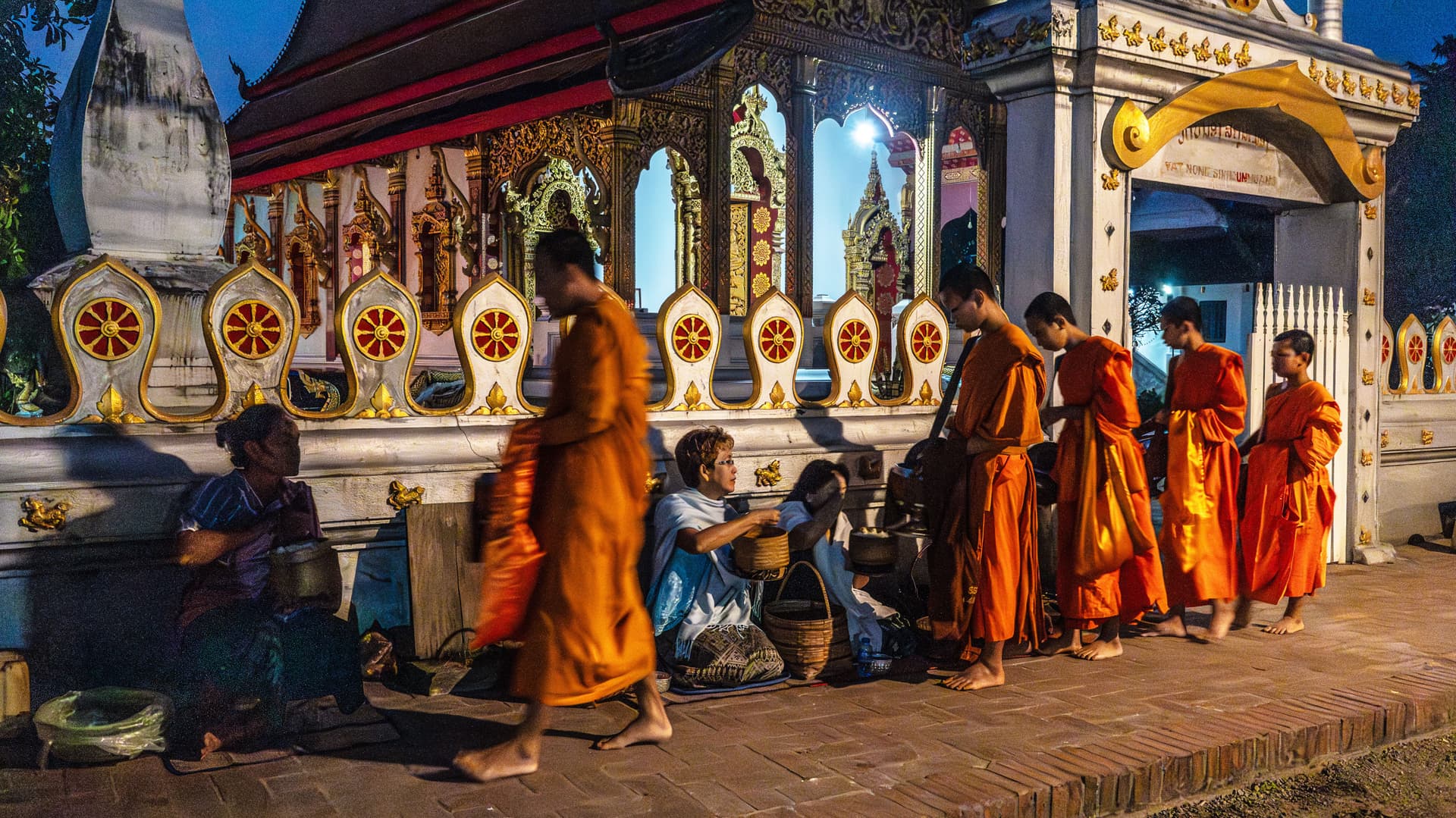
Theravada Buddhism is the spiritual heartbeat of Laos, deeply woven into the country’s cultural and social fabric. Golden-roofed wats (temples) grace every village, and saffron-robed monks collecting alms at dawn are a daily rhythm of life. It is customary for Laotian men to spend a period, often during adolescence, living as a monk, a rite of passage that fosters humility, discipline, and spiritual grounding.
Buddhist values such as merit-making, detachment, and compassion guide interpersonal behavior and community rituals. But religion in Laos is also a quiet mosaic of traditions, especially among ethnic minorities in mountainous regions. Buddhism often coexists with animist beliefs, ancestral worship, and shamanistic practices. You’ll spot spirit houses, ceremonial offerings, and sacred trees in homes and businesses alike.
Religious festivals are vibrant affairs steeped in symbolism and celebration. The Pi Mai Lao (Lao New Year) in April is marked with water blessings and street festivities, while the luminous That Luang Festival in Vientiane each November brings pilgrims from across the nation to honor the country’s most sacred stupa.
GEOGRAPHY
Laos spans 236,800 square kilometers (91,400 square miles), roughly the size of the United Kingdom. As Southeast Asia’s only landlocked country, it is encircled by five nations - China, Vietnam, Cambodia, Thailand, and Myanmar, yet maintains a distinctly serene and self-contained identity shaped by nature more than borders.
The lifeblood of the country is the Mekong River, which flows for over 4,000 kilometers across Asia and forms much of Laos’ western boundary. Its fertile banks nourish rice paddies, floating villages, and spiritual traditions, especially in lowland areas. Yet beyond the Mekong’s gentle flow lies a wilder realm, over 70% of Laos is mountainous, dominated by forested highlands, misty ridges, and dramatic karst formations.
Laos ranges from an average elevation of 710 meters (2,330 feet) above sea level to its highest point, Phou Bia, which towers at 2,820 meters (9,252 feet). This topographical diversity creates rich biodiversity and pronounces microclimates. Early mornings in the highlands can feel refreshingly cool, even during the hot season.
With one of the lowest population densities in Asia, Laos offers a rare sense of stillness. In the north, places like Luang Prabang and Phongsaly are cooler, culturally rich, and visually striking with their mountain silhouettes and ethnic mosaic. The south, including Pakse and Champasak, opens to warmer plains, tranquil river islands, and the lush Bolaven Plateau, known for its waterfalls and coffee plantations.
Recommended Books
- The History of Laos: From Monks to Manuscripts (2023): A comprehensive exploration of Laos' rich past
- A Short History of Laos: The Land in Between by Grant Evans (2002): The most authoritative modern overview of Lao history.
- Another Quiet American: Stories of Life in Laos - Brett Dakin (2003): A candid memoir capturing post-war Laos through an expatriate’s eyes.
- Ant Egg Soup: The Adventures of a Food Tourist in Laos - Natacha du Pont de Bie (2008): A delightful culinary travelogue exploring Lao culture through food.
- The Ravens: The True Story of a Secret War in Laos - Christopher Robbins (2000): A riveting account of America’s covert operations during the Vietnam War.
Recommended Movies
- Good Morning, Luang Prabang (2008): The first Lao romantic film in decades, highlighting everyday life and love.
- The Rocket (2013): Critically acclaimed drama of resilience in a changing rural Laos.
- Blood Road (2017): A powerful documentary retracing the Ho Chi Minh Trail.
- Dearest Sister (Nong Hak) (2016): A psychological thriller blending folklore with modern urbanization.


